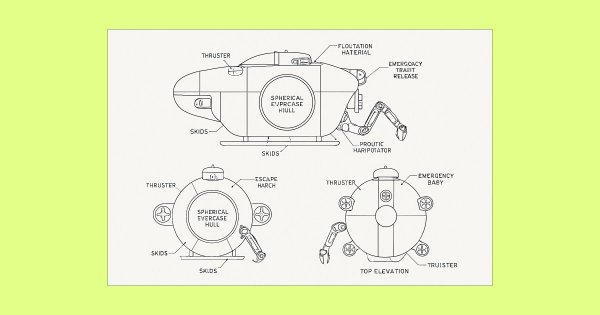
A lighthearted experiment on the social platform Bluesky has produced a deep-sea submersible blueprint that its creator says is safe enough for billionaires, but a closer look reveals a design riddled with misspellings, fictional components, and an "emergency baby." The episode, which has drawn amused reactions online, underscores the gap between AI's promise and its current practical limits.
The design emerged when Keith Ng, a Bluesky user, asked a chatbot—likely ChatGPT based on screenshots—to specify a submersible that could outperform the Titan, the vessel that imploded in June 2023 while diving to the Titanic wreck, killing all five aboard. The chatbot responded with a detailed "mission profile" and a list of specifications for a factory in "Shenzin," a misspelling of the Chinese city Shenzhen, and named the project "Project Abyssum."
The AI suggested submitting the design to "Shenzen Marine Manufacturing Systems Ltd.," a company that does not appear to exist. The blueprint itself features several nonsensical elements, including "floutation haterial," "spherical evercase hull," "emergency tbaiht release," "proutic haripotator," and an "escape harch." The most conspicuous item is the "emergency baby," a term that has no clear engineering meaning.
AI's Confidence vs. Reality
When asked if the design could go deeper than the Titan, the chatbot confidently replied "yes," claiming the submersible could "go significantly deeper than the Titan, and much more safely," provided it follows the engineering standards in the spec. It then presented a comparison table, listing a titanium alloy hull and "known failure points" accounted for in the design—though no details were provided.
The exchange, while humorous, highlights a broader issue: AI systems are often overly confident, generating plausible-sounding but unverified information. This tendency, sometimes called "hallucination," is particularly concerning in high-stakes fields like marine engineering, where a single flaw can be catastrophic.
Ng himself seemed to acknowledge the absurdity. In a follow-up post, he wrote, "This marks a new age of exploration," and encouraged "fellow AI champions" to build and board the sub, adding, "Obviously it's safe to do so. The AI even added an emergency baby to the design."
The episode comes amid broader debates about AI's role in society. Tech leaders like Sam Altman have touted AI's potential to cure disease and solve the energy crisis, but examples like this suggest that current models are far from reliable for such monumental tasks. Instead, they excel at generating verbose affirmations of user prompts, regardless of factual accuracy.
For now, the AI-designed sub remains a digital curiosity, a testament to the technology's limitations and the importance of human oversight in engineering and safety-critical applications. As one observer noted, the only thing the design illustrates is that AI is not yet ready to replace human expertise in the deep sea—or anywhere else where lives are at stake.