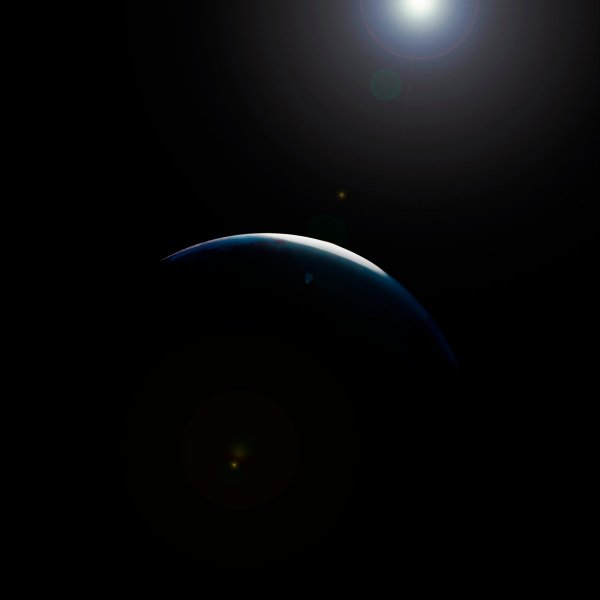
Astronomers have pinned down the physical characteristics of a distant icy body lurking at the edge of our solar system, revealing it to be a substantial world with a surprisingly dark surface. The object, informally named DeeDee (short for Distant Dwarf), was first spotted in late 2016 but its true nature remained unclear until now.
New observations from the Atacama Large Millimeter/submillimeter Array (ALMA) in Chile show that DeeDee is roughly two-thirds the diameter of Ceres, the largest member of the asteroid belt. With enough mass to pull itself into a sphere, DeeDee qualifies as a dwarf planet, though astronomers have yet to officially classify it as such.
Located about 92 astronomical units from the Sun—approximately 137 billion kilometers or 86 billion miles—DeeDee sits far beyond Pluto. Sunlight takes roughly 13 hours to reach it, making it one of the most distant known trans-Neptunian objects, second only to the dwarf planet Eris. Its orbit is immense, taking about 1,100 years to complete a single lap around the Sun.
A Dark and Cold Neighbor
The ALMA follow-up, led by researcher David Gerdes, provided the first reliable measurements of DeeDee's size and reflectivity. The team calculated that the object's temperature hovers around 30 Kelvin, just above absolute zero. They also determined that DeeDee reflects only about 13 percent of the sunlight that hits it, making it roughly as bright as a candle viewed from halfway between Earth and the Moon—yet it was still detectable.
“ALMA picked it up fairly easily,” Gerdes said in a news release from the National Radio Astronomy Observatory (NRAO). “We calculated that this object would be incredibly cold, only about 30 degrees Kelvin, just a little above absolute zero.”
DeeDee was initially discovered by researchers at Chile’s Cerro Tololo Inter-American Observatory during the Dark Energy Survey. At the time, astronomers were uncertain whether it was small and highly reflective or large and dark. The ALMA observations settled the question, confirming its unusual size and darkness.
Why This Matters
The discovery of DeeDee underscores how much of our solar system remains uncharted. “Far beyond Pluto is a region surprisingly rich with planetary bodies,” Gerdes noted. “Some are quite small but others have sizes to rival Pluto and could possibly be much larger.”
Objects like DeeDee are considered remnants from the solar system’s formation, offering clues about how planets evolved. They also serve as benchmarks for the capabilities of modern telescopes, such as the upcoming James Webb Space Telescope, which is expected to push the detection of such distant, slow-moving bodies even further.
DeeDee’s story is a testament to the rapid advancement of astronomical technology. What began as a faint blip in a survey has become a well-characterized world, and it hints at the many more discoveries awaiting astronomers on the fringes of our cosmic neighborhood.