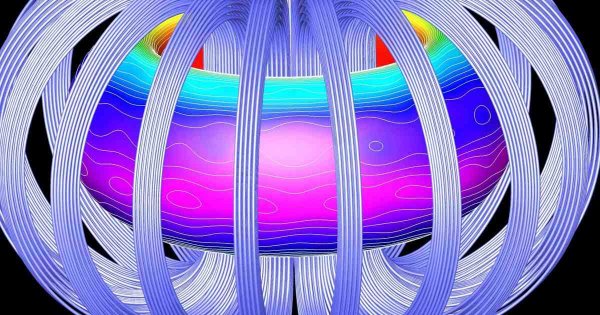
In the quest to harness fusion energy, a team at Princeton University has proposed a novel method to tame the superheated plasma that fuels experimental reactors. Their theoretical work, published in the journal Physics of Plasmas, suggests that targeted radio frequency waves could suppress disruptive structures known as magnetic islands, which often destabilize fusion reactions.
Fusion reactors rely on plasma—an ionized gas so hot it rivals the Sun's core—to fuse light elements and release energy. But this plasma is notoriously volatile, and even minor perturbations can cause it to become chaotic, leading to sudden energy releases that interrupt the reaction. Controlling this instability has been a central challenge for decades.
The Princeton team, led by graduate student Eduardo Rodriguez of the Princeton Program in Plasma Physics, focused on magnetic islands—bubble-like formations that emerge within the plasma and can trigger these sudden energy dumps. By applying radio frequency waves that super-heat the plasma, the researchers believe they can prevent these islands from growing, thereby maintaining a more stable reaction environment.
“We want the islands not to grow,” Rodriguez explained in a statement. “Focusing on this can lead to improved stabilization of fusion reactors.”
Why Magnetic Islands Matter
Magnetic islands are not just a theoretical curiosity; they pose a practical threat to fusion efficiency. When these structures expand, they can cause the plasma to lose confinement, leading to a loss of energy and potentially damaging the reactor walls. The proposed technique aims to intervene early, using radio waves to exert control over the plasma's behavior.
The study is purely theoretical, but it offers a promising avenue for experimental testing. If validated, this approach could complement existing stabilization methods, bringing fusion reactors one step closer to delivering clean, abundant energy.
While the paper does not provide experimental data, it builds on a growing body of research exploring radio frequency control in plasma physics. The findings were also highlighted by Popular Mechanics, which noted the potential of the radio wave breakthrough.
Fusion energy has long been hailed as a potential solution to global energy needs, but practical realization has remained elusive. This latest theoretical advance adds to the incremental progress that could eventually make fusion a viable power source.