An astrophysicist has designed a theoretical stellar engine that could move the entire solar system, offering a potential escape from cosmic threats that cannot be stopped. Matthew Caplan of Illinois State University created the concept, dubbed the Caplan Thruster, at the request of the Munich-based YouTube channel Kurzgesagt. A paper describing the machine has been published in the journal Acta Astronautica, and Kurzgesagt produced a video illustrating the device.
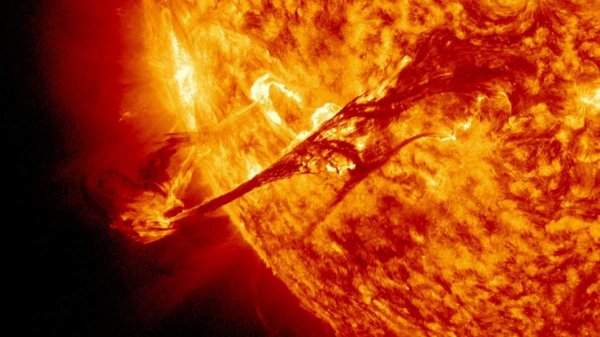
The Caplan Thruster would operate like a rocket positioned near the Sun. It would use a Dyson sphere to collect mass from the star, separating it into hydrogen and helium. The helium would be burned in fusion reactors to generate thrust, while a jet of accelerated hydrogen particles would be fired at the Sun to prevent the machine from colliding with it.
This would allow the thruster to act as a giant tugboat, pushing the Sun from its current location to a new one at a speed of about 50 light years per one million years. While that pace may seem slow, Kurzgesagt's video notes that events necessitating such a stellar engine—such as an asteroid shower or a nearby supernova—would likely be detectable thousands or even millions of years in advance. That lead time would make the Caplan Thruster fast enough to move the Sun out of harm's way. Because of gravity, Earth and the other planets would follow the Sun to its new location.
The concept remains theoretical, and no timeline for construction or deployment has been proposed. It addresses scenarios where deflection or destruction of a single threat is insufficient, such as a widespread asteroid shower or an impending supernova. The research was published in Acta Astronautica, and the Kurzgesagt video provides a visual explanation of the proposed mechanics.



Editorial Notes