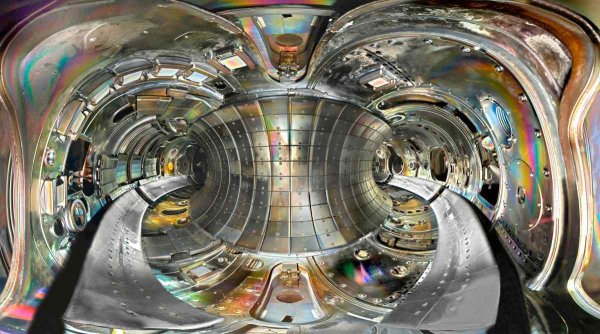
CAMBRIDGE, Mass. — A senior physicist who led one of MIT's flagship fusion experiments says the technology could be feeding electricity into the grid within the next decade, provided research efforts remain focused. Earl Marmar, former head of the Alcator C-Mod tokamak project, told Inverse that a 2030 target for fusion power is "certainly within reach," while acknowledging the timeline is "aggressive" but not unrealistic.
The statement comes amid a global push to commercialize fusion, a process that has long promised abundant clean energy but has struggled to move beyond the laboratory. Unlike nuclear fission, which splits heavy atoms, fusion combines lightweight hydrogen nuclei into helium, releasing energy in a reaction that powers the sun and other stars. The challenge is recreating those conditions on Earth — requiring temperatures exceeding 30 million degrees Celsius — and then holding the resulting plasma stable long enough to extract net energy.
Marmar, who spent more than two decades overseeing the donut-shaped Alcator C-Mod reactor before it was decommissioned, said the fundamental physics of fusion is no longer in question. "We know that fusion works; we know that the nuclear physics works," he said. "There are questions left on the technology side." That distinction is crucial: the obstacle is not understanding the reaction, but engineering a system that can sustain it reliably and economically.
Two Approaches to Taming the Plasma
Efforts to stabilize fusion are already underway, with different strategies being tested around the world. In the United Kingdom, Tokamak Energy has shrunk the central hole of its reactor to increase plasma density. At MIT, researchers are focusing on strengthening the magnetic field that contains the superheated plasma. Meanwhile, an international consortium funded by 35 countries is building ITER in southern France, the largest fusion experiment ever attempted.
Marmar's optimism is tempered by the scale of the work still required. He cautioned that even with dedicated funding and research, the 2030s could prove a challenging deadline. But he also warned that delaying action could push fusion's arrival back by a decade or more. "We need to get going, because the need for fusion energy is very urgent, specifically in view of climate change," he said.
The urgency reflects a broader shift in how fusion is perceived. Once seen as a distant dream, it is now a focal point of public and private investment, with startups and national programs racing to prove commercial viability. Marmar's comments add a senior voice to the growing consensus that the remaining barriers are engineering hurdles, not scientific mysteries.
For now, the clock is ticking. Whether fusion can meet the 2030 target depends on sustained commitment from governments, industry, and research institutions. As Marmar put it, a little pressure might be exactly what the field needs.